A catalogued sea cave
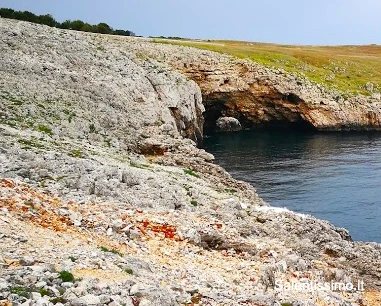
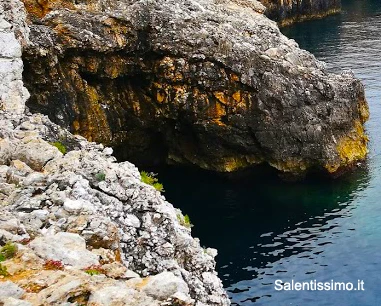
Grotta Palombara is an Otranto sea cave catalogued as PU 153 and also known as Grotta dell’Alga. It opens in the limestone cliff of the Palombara-Orte sector.
Do not confuse it
Another Grotta Palombara exists at Castro; this page is only about Otranto.
Coastal karst and marine action, not simply a collapse
Research on Cape Otranto caves links their development to rock fracturing, coastal karst, ancient sea-level changes and wave erosion.
Good to know
Its origin should not be reduced to one limestone-wall collapse.
Advertisement
About 25 metres of development
The scientific description gives about 25 m of development. The main passage rises to a small air pocket and has smaller northern entrances.
Important
Morphology data are not an invitation to enter without suitable conditions and skills.
Mostly sandy inner floor
Inside, the floor is described as mainly sandy with a central limestone outcrop; very rounded pebbles occur outside.
Not shallow water
Seabed type and depth are different things.
Freshwater seepage is documented inside
Scientific research records freshwater emerging from fractures in the cave roof.
What can vary
The amount can vary and says nothing about safety or drinkability.
A small upper cavity with formations is described
Above the entrance, on the emerged cliff, a small cavity with stalactite-stalagmite formations has been documented.
Protect it
Do not touch formations or seek unofficial access routes.
From land: mainly a panoramic viewpoint
The coastal trail reaches the cave area from above. Near the cave it narrows and continues over exposed rock.
Meaning
Land access does not mean there is an easy walking descent into the cave.
A hiking trail, not a flip-flop walk
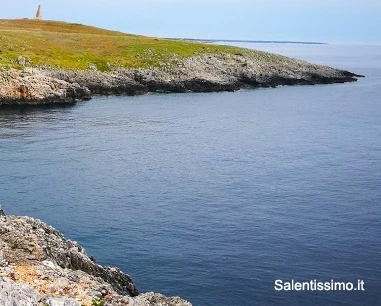
The Orte route continues towards Cape Otranto and Punta Palascia. The cave section needs care on exposed rock close to the cliff.
Footwear
Use walking shoes and avoid shortcuts towards the edge.
The cliff hosts a jackdaw colony
The cave and surrounding cliff are identified as a nesting site for a colony of jackdaws.
Respect wildlife
Keep away from nests, avoid drones and unnecessary noise.
Rockfall risk is essential information
Updated 2026 nautical information continues to list rockfall restrictions between Grotta Palombara and Grotta delle Orte and along the Baia delle Orte cliff.
Before approaching
Check current signs, buoys, barriers and orders; never cross closures.
Where restrictions apply, sea activities can also be prohibited
In affected 30–50 m coastal safety bands, bathing, navigation, anchoring or stopping, fishing and underwater/surface activities may be prohibited.
Major correction
We no longer recommend routinely reaching the cave by swimming or boat.
Snorkelling: interesting only where permitted
The rocky coast is naturally interesting underwater, but safety restrictions always take priority.
Rule
Snorkel only in open bathing sectors, in calm water and outside restricted bands.
Open sea and cliff: assess conditions each time
Wind, waves and backwash can make cliff faces, entrances and rocks dangerous. Clear water does not equal safe water.
If conditions change
Move away from the cliff and use an easier bathing access.
Families: a viewpoint, not a children’s beach
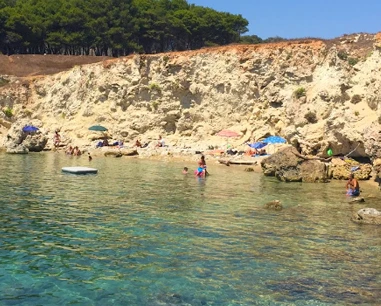
There is no sandy beach, shallow uniform seabed or easy entry here. The exposed trail and cliff restrictions make it unsuitable as a children’s bathing destination.
With children
Enjoy it as a scenic stop and swim elsewhere.
No beach facilities at the cave
No bar, toilets, showers, hire or bathing assistance are assigned to Grotta Palombara itself.
Come prepared
Carry water and sun protection for the walk.
Parking: use authorised areas
Local rules restrict irregular driving and parking in natural/wooded areas. In 2026 Otranto municipal parking is paid from 1 April to 31 October.
For the visit
Walk to the trail rather than driving towards the cliff.
Accessibility: no specific assisted bathing access
We found no assisted-bathing service for the cave. Narrow trail and exposed rock can be major barriers.
Alternatives
Use equipped sea accesses elsewhere in Otranto if you need bathing aids.
Water quality: no permanent crystal-clear guarantee
Use current official bathing-water monitoring for sanitary status rather than permanent visual claims.
Remember
Visual clarity, sanitary quality and sea safety are different things.
Best for
Hikers, coastal-geology enthusiasts, birdwatchers, photographers and visitors interested in Cape Otranto sea caves.
Best way to experience it
As a natural and panoramic stop, strictly respecting current restrictions.
What to bring
Light hiking shoes, water, hat, sunscreen and binoculars or a camera. Snorkelling gear only makes sense if you move to a sector where bathing is permitted.
Priority
Check current restrictions and trail conditions before equipment.