Leuca cave, not Patù
Castrignano del Capo municipality lists it among the western Leuca caves.
`-felloniche` remains only in the filename.
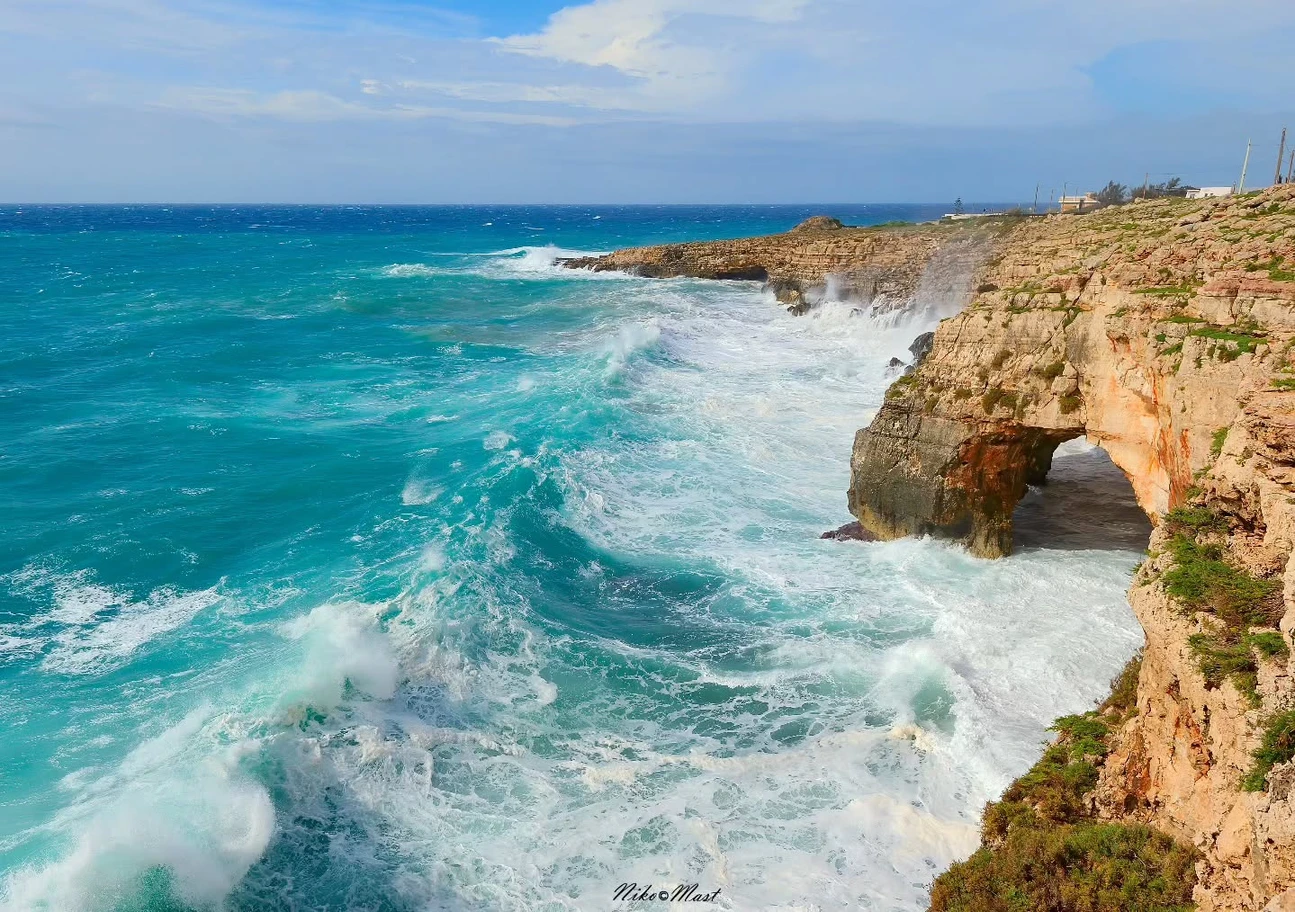
A large sea cave on Leuca’s Ionian coast, beyond Grotta dei Giganti, with two semi-submerged entrances and a tradition of sheltering fishermen during storms.
The historic page placed it under Felloniche and encouraged diving. The updated guide correctly places it in Castrignano del Capo and focuses on documented morphology, palaeontological interest and historical shelter use.
Castrignano del Capo municipality lists it among the western Leuca caves.
`-felloniche` remains only in the filename.
Mapped at 39.7958, 18.33552 in Castrignano del Capo.
Grotta dei Giganti is about 140 m east.
The speleological literature gives about 40 m horizontal development.
This is not a guaranteed tourist route inside.
The survey describes a mostly aerial chamber around 25 m wide and 40 m long.
Stalagmites and rock colours are documented.
The municipality explicitly identifies Grotta della Stalla as being of palaeontological interest.
Do not disturb formations or collect material.
Municipal and local tradition say fishermen used the cave as shelter during storms.
The name is commonly linked to this shelter function.
It is observed on western Leuca boat routes.
Approach depends on sea and skipper instructions.
Viewing from the boat may suit many visitors; accessibility depends on the vessel.
Ask about children, life jackets and reduced mobility.
Water, hat, sunscreen, waterproof case, light towel and wind layer.
Bring a mask only if the tour includes an authorised swim stop.
mapping sources/mapping sources coordinates: 39.7958, 18.33552. The cave is in Castrignano del Capo; Felloniche remains only in the historic filename.
The gallery shows the available and verified photographs for this place.
Have you photographed this beach or a beach club located here? Send your image to Salentissimo.it.
The photo and the details you enter will be emailed to the editorial team and checked before possible publication among the photographs of this beach.
Do you own or manage a beach club or bathing establishment? Claim your listing free of charge: email us a photo, a short description, your contact details and a link to your website. We will create an updated card with the information you provide.
Add it free of charge by emailing us the business details.
Add your beach clubThe caves are close together but remain separate guides because of their different form, history and natural interest.
Una cavità della costa di Leuca documentata nella storica raccolta di schede di Salentissimo.
Open guideGrotta di Punta Ristola di notevole interesse naturalistico e archeologico.
Open guideIl promontorio sul versante di ponente, tra i luoghi simbolo di Santa Maria di Leuca.
Open guideCavità di grande interesse storico, con iscrizioni e testimonianze antiche.
Open guideSistema di cavità marine sul litorale di Leuca, raggiungibili principalmente dal mare.
Open guideCavità marine della costa di Leuca inserite tra i luoghi della marina.
Open guideIl promontorio di Leuca, con il faro, la basilica e la grande scalinata monumentale.
Open guideGrotta marina del versante di levante della costa di Santa Maria di Leuca.
Open guideCavità marine del tratto costiero orientale della marina.
Open guideUna falesia alta e scenografica del litorale adriatico di Leuca.
Open guideUna cavità marina della costa di Leuca già documentata su Salentissimo.
Open guideGrotta marina inserita nel sistema di cavità del litorale di Leuca.
Open guideCavità marina del tratto costiero di Leuca già presente nell'archivio Salentissimo.
Open guideLa torre costiera cinquecentesca nota anche come Torre dell'Uomo Morto.
Open guideDo you run a hotel, B&B, residence, holiday home or other accommodation? Claim your listing free of charge: email us a photo, a short description, your contact details and a link to your website. We will create an updated card with the information you provide.
Editorial geography follows Santa Maria di Leuca; the old Felloniche filenames remain only for migration.
Geography, sea visits, cave features, safety and families.