Quattro Colonne: what to know before entering the sea
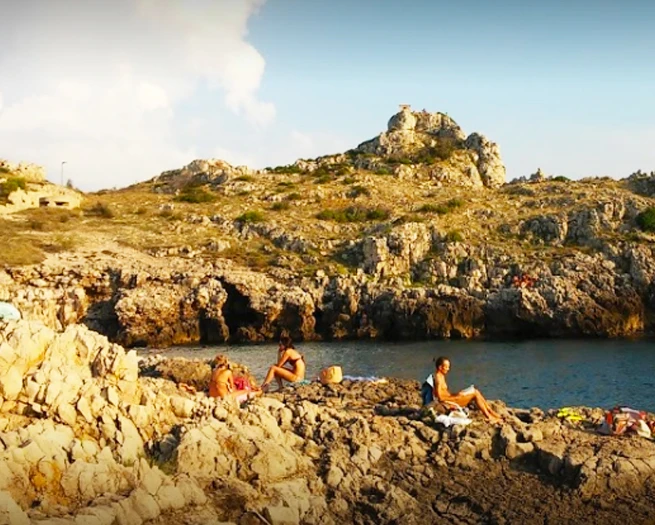
This is not a proper sandy beach: swimming is mainly from the rocks. The area is easy to reach from town, but seabed, access, parking and services must be distinguished between public space and private businesses.
Low rocky coast, not a sandy beach
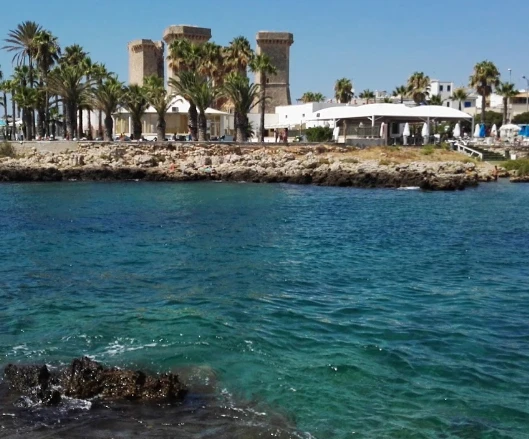
The shore in front of the Quattro Colonne is mainly rock, with natural platforms, small rock pools and entry points into the sea. Santa Maria al Bagno’s small sandy beach is closer to the centre.
First choice
If you want sand under your towel or have very young children, the central bay is usually easier.
Rocky, irregular seabed
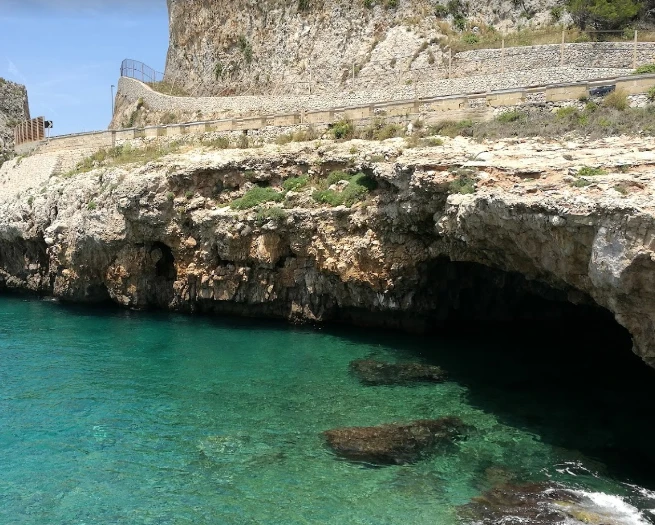
The bottom in front of the rocks includes stone, rock, crevices and deeper pockets. It is interesting underwater but should not be treated as uniformly shallow.
Careful entry
Check depth and footing before entering or jumping. Water shoes are recommended.
Advertisement
The Galatena spring explains the tower’s old name
Torre del Fiume was built near an important freshwater spring used by people travelling along the coast. Water can feel noticeably cooler near freshwater outflows, but it is inaccurate to attribute the whole rocky shore’s temperature to generic ‘cold currents’.
What you may feel
A sudden cooler patch close to shore is compatible with local freshwater input.
Families: better for confident swimmers used to rock
The area can suit families with older children who swim confidently and are used to rocky entries. With a pushchair, toddlers or anyone wanting a gradual sandy entry, the central bay is easier.
With young children
Avoid jumps and slippery points; choose the simplest entry and stay close even when the sea looks calm.
How to get there: seafront and Piazza Shalom
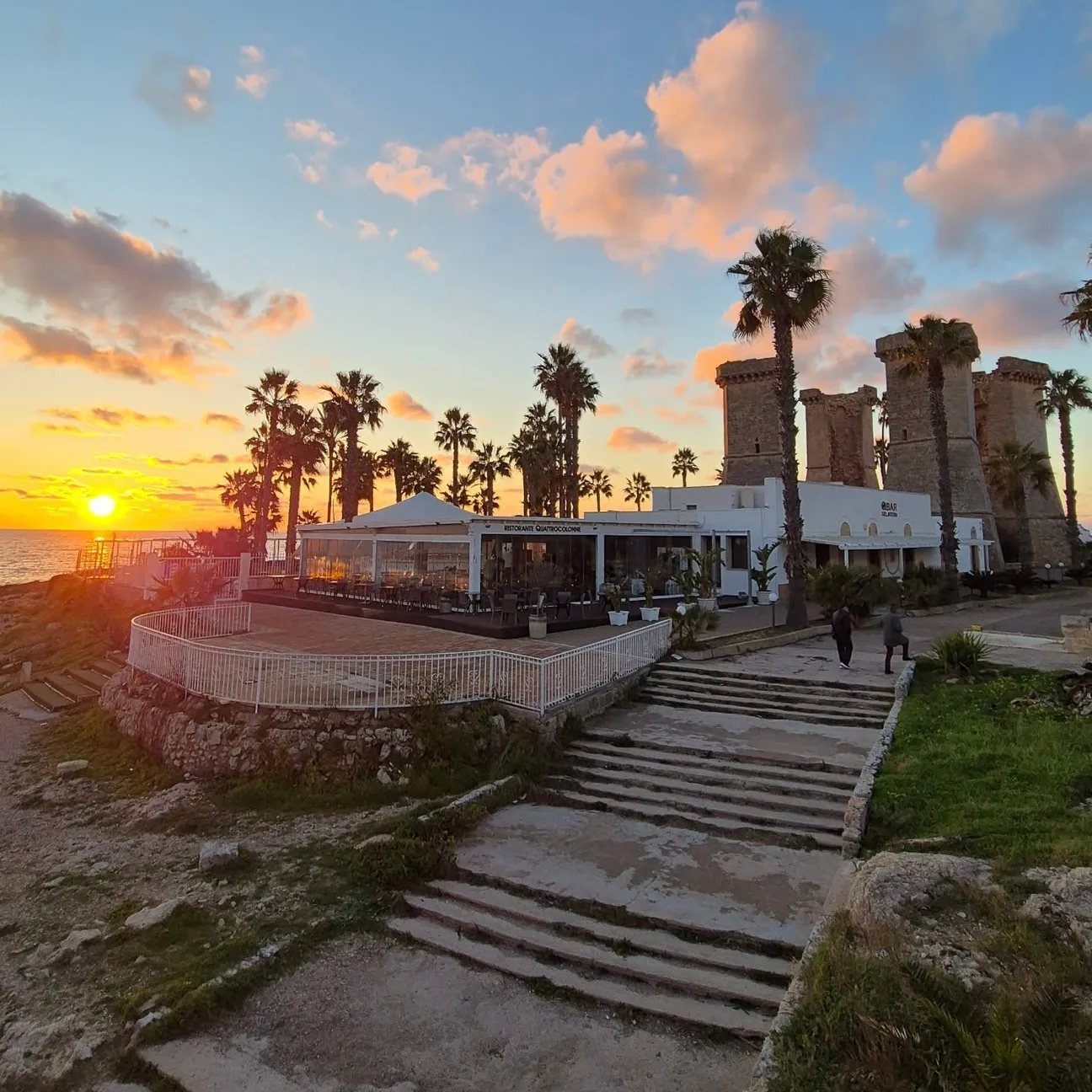
The Quattro Colonne stand on the Santa Maria al Bagno seafront along the coastal road towards Lido Conchiglie and Gallipoli. Largo Quattro Colonne is a public space with free access and the monument is clearly visible from the road.
Walk from town
From central Santa Maria al Bagno it is easy to walk, avoiding a second search for parking.
Parking: urban area with seasonal rules
There is no guaranteed free public space directly beside the rocks. Parking depends on signs, road markings, ZTL restrictions and events in Largo Quattro Colonne. Private businesses may have parking reserved for customers.
In summer
Check the day’s signs and never assume a private car park is public.
Bars and food nearby
This is an urban, non-isolated setting. Food businesses and event venues operate along the seafront; one private facility nearby also advertises a bar, customer parking and private sea access.
Public or private?
Facilities belonging to businesses are private: check opening, conditions and availability before relying on them.
Accessibility: the square is urban, the rocky sea access is not verified
The public area in front of the monument is reached from the road, but we found no current confirmation of an equipped public descent to the sea with boardwalk or beach wheelchair on this exact rocky section.
Reduced mobility
For getting into the water, check an equipped beach nearby; road access to the monument does not automatically mean accessible sea access.
Sea and wind: rock needs extra care
In calm weather the water can be very clear and the rocks enjoyable for swimming and snorkelling. With waves and wind, getting into and especially out of the water becomes harder on rock.
Practical rule
In rough water avoid exposed entry points and choose a sandy beach if you are not confident on rocks.
Snorkelling: one of the best reasons to stop
Rock, crevices and changes in seabed make this stretch more interesting with mask and snorkel than a fully sandy bay. Visibility depends on wind, waves and boat activity.
How to do it
Stay close to shore, use a marker buoy if going farther out and do not remove marine life, rock or finds.
Torre del Fiume di Galatena: four surviving bastions
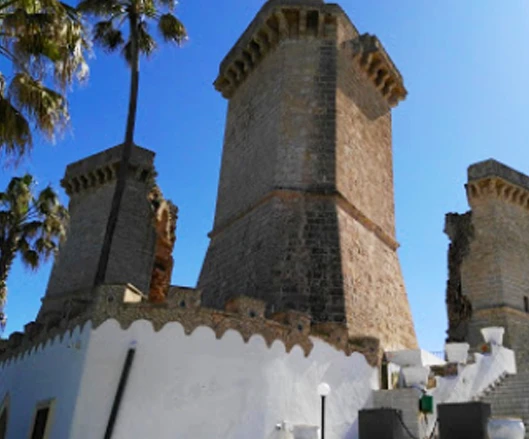
The monument began as a late-16th-century coastal fortification protecting the spring and shoreline. Its central body collapsed, leaving the four corner bastions that gave the site its modern name. The cause of the collapse is not established with certainty.
Important correction
An earthquake is only one traditional hypothesis and should not be stated as proven fact.
Crowds: usable rock space is limited
The best places on the rocks are limited and the site is very visible from the seafront. At weekends, during events and in peak summer, only a few groups can make the best sea-entry points feel crowded.
For more space
Early morning or late afternoon are easier; also check whether an event is scheduled in the square.
From 2026: tourist info point and summer ZTL
From June 2026 the Quattro Colonne tourist information point reopened. In summer 2026 Santa Maria al Bagno also had an evening ZTL from 20 June to 15 September, 21:00–02:00; future seasons should always be checked again.
If arriving by car
Check current traffic rules before travelling: a seafront monument is not always reachable or parkable directly by car.
Blue Flag 2026 for Santa Maria al Bagno
In 2026 Santa Maria al Bagno was among Nardò’s Blue Flag coastal areas, together with Porto Selvaggio, Sant’Isidoro, Santa Caterina and Torre Squillace.
What it means
The award concerns coastal quality and management; it does not mean every individual rocky entry has all facilities.
Best for
People who enjoy low rocky shores, swimming and snorkelling, couples and younger visitors comfortable on rock, and anyone combining a quick swim with one of Santa Maria al Bagno’s best-known historic landmarks.
Main appeal
The combination of sea and monument is the strength, with the town and services close by.
Less suitable for
Anyone wanting sand under the towel, uniformly shallow water, verified step-free sea access, very young children or a fully serviced beach club directly on the spot.
Nearby alternative
For sand and a gentler entry choose the central Santa Maria al Bagno beach.
What to bring
Water shoes, mask and snorkel, a thicker towel or mat for the rocks, sun protection and water. Bring shade if staying long because the rocky coast has little continuous natural shelter.
Essential
Water shoes are the most useful item for both moving over rock and entering the irregular seabed.